


Freeze-drying guide for Malaysian food producers · Updated November 2026
Freeze-Drying in Malaysia: Why Humidity Spoils Food So Fast
Short answer Malaysia's mean relative humidity runs 72.8–87.8% and lowland temperatures sit at 25–32°C. That combination lets dry food reabsorb moisture, pushes water activity back up and collapses shelf life. Freeze-drying removes 97–99% of the water at low temperature, and with moisture-barrier packaging it moves a product from weeks of freshness to 12–24 months without refrigeration.
Written for processors, co-packers and exporters sourcing freeze-drying capacity in Malaysia and Southeast Asia.
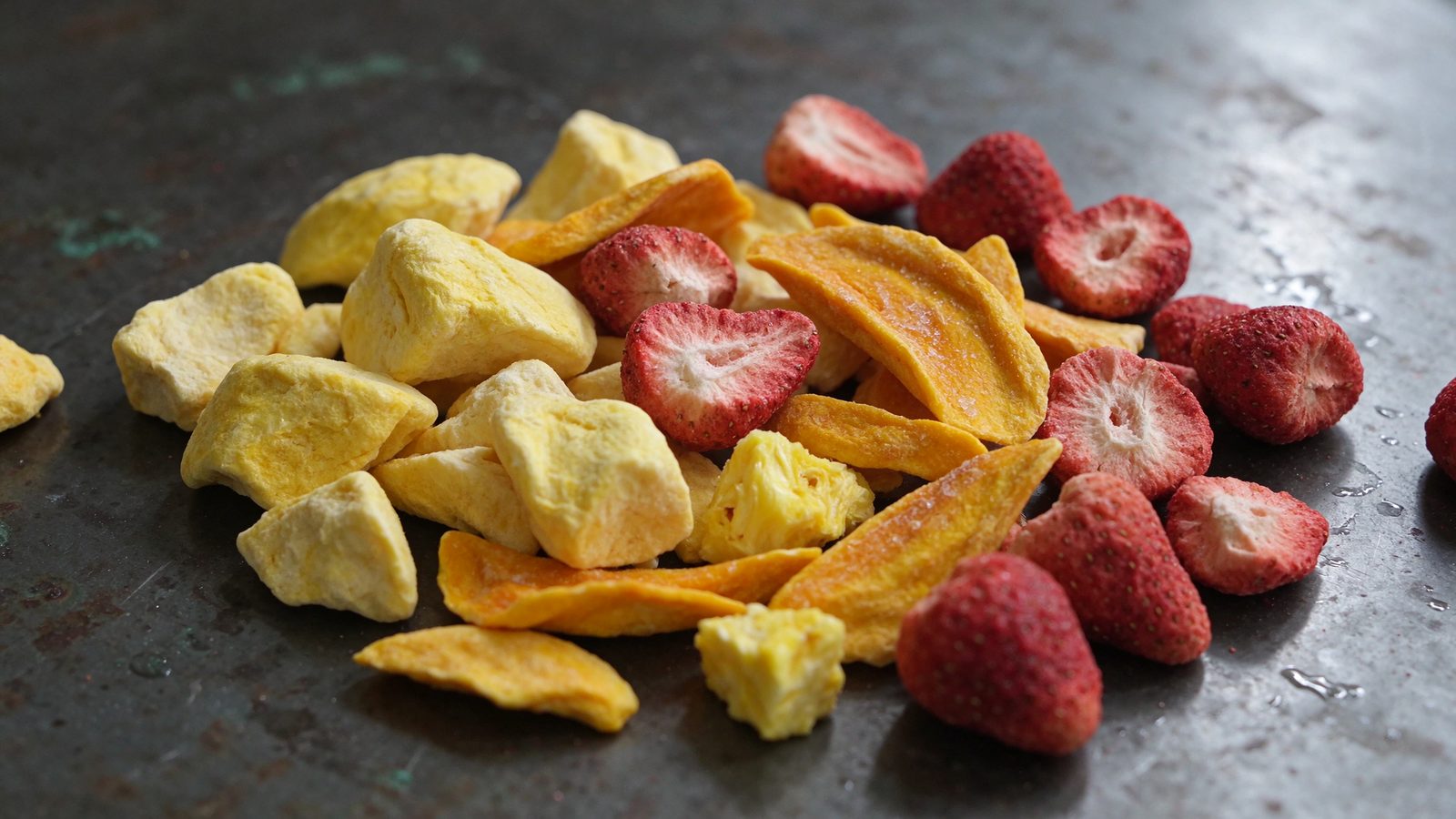
Freeze-dried durian, mango and pineapple. Water removed, structure kept.
72.8–87.8%
Mean relative humidity, Malaysia, 2024
Dept. of Statistics Malaysia
25–32°C
Typical lowland temperature range
Year-round, no dry season
aw 0.08–0.33
Water activity of well freeze-dried food
Residual moisture 1–3%
12–24 mo.
Realistic retail shelf life in barrier pouches
Requires product-specific testing
Humidity is the spoilage driver, not background noise
Malaysia has no true dry season. Even the driest months stay humid, and warehouses, kitchens and retail shelves drift higher near the coast and after rain.
A packet opened at lunch feels soft by evening. Crackers lose their crunch, dried fruit turns tacky, powders clump and nuts go stale long before the label suggests. For a business that is not an inconvenience but a line item: shorter shelf life, avoidable waste, returns and products that are hard to ship consistently.
Six routes run at once in warm, humid air, and all six share one accelerant — water that should not be there.
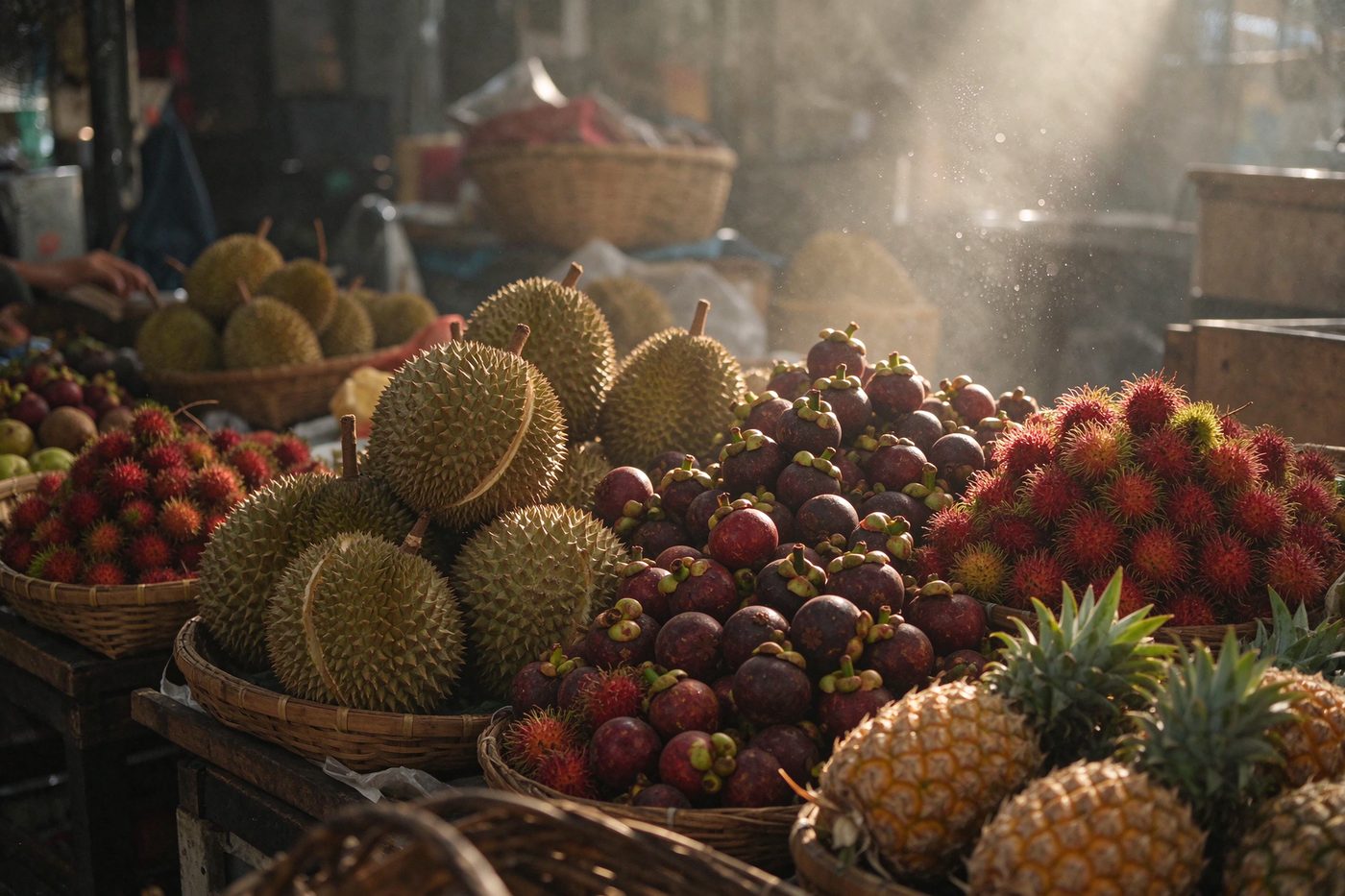
Tropical fruit is cheap at harvest, expensive to move and quick to spoil. That gap is the commercial case for freeze-drying.
| Route | What humid, warm air does | What you see or taste |
|---|---|---|
| Mould and yeastaw above 0.60 | Finds a foothold wherever water is available | Fuzz, off-flavour, discolouration |
| Bacteriaaw above 0.85–0.91 | Multiplies once free water returns | Souring, gas, slime |
| Moisture uptake | Hygroscopic solids pull water straight out of the air | Soft texture, clumping, sticky surfaces |
| Lipid oxidation | Heat accelerates rancidity in fats and nuts | Stale, oily, cardboard notes |
| Colour and aroma | Heat plus oxygen degrade pigments and volatiles | Faded colour, flat smell |
| Insects and pests | Warm, damp storage favours breeding | Webbing, holes, live activity |
Shelf life depends on the food, the process, the handling and the pack. There is no single number that applies to every product — which is why the pack, not the label, decides the claim.
Water activity (aw): the number that decides shelf life
Water activity is the share of water available for microbial growth and chemical reactions. It runs from 0 (bone dry) to 1 (pure water), and it is not the same as moisture content.
00.600.85 · 1.0
Below 0.60 — most spoilage bacteria, yeasts and moulds cannot grow. Shelf-stable.
0.60–0.85 — the danger band for dried goods kept in humid air.
Above 0.85 — many bacteria active; refrigeration or another hurdle becomes mandatory.
A product leaving the dryer at aw 0.2 does not stay at 0.2. Every hour in Malaysian air it climbs. The dryer sets the starting point — the packaging decides how long that point holds.
Refrigeration solves temperature, not moisture
Cold storage works, and for some categories it is the right answer. But it changes the nature of the business rather than the product.
Permanent operating cost
Continuous cooling consumes energy and floor space, and it competes with production capacity.
Distribution friction
Cold chain to retailers, hotels, island communities in Sabah and Sarawak, or export markets adds equipment, handling steps and failure points.
Condensation
Cold packs meeting 80%+ ambient air sweat. Wet cartons, damaged labels and moisture on the product are routine.
Texture damage
Freezing and thawing breaks cell walls; crisp products come back limp and drip on thaw.
Refrigeration answers “how do we keep this cold?”. It is a poor answer to “how do we make a product stable, portable and appealing without losing its character?”. For the second question the water has to leave the product, not be chilled around it.
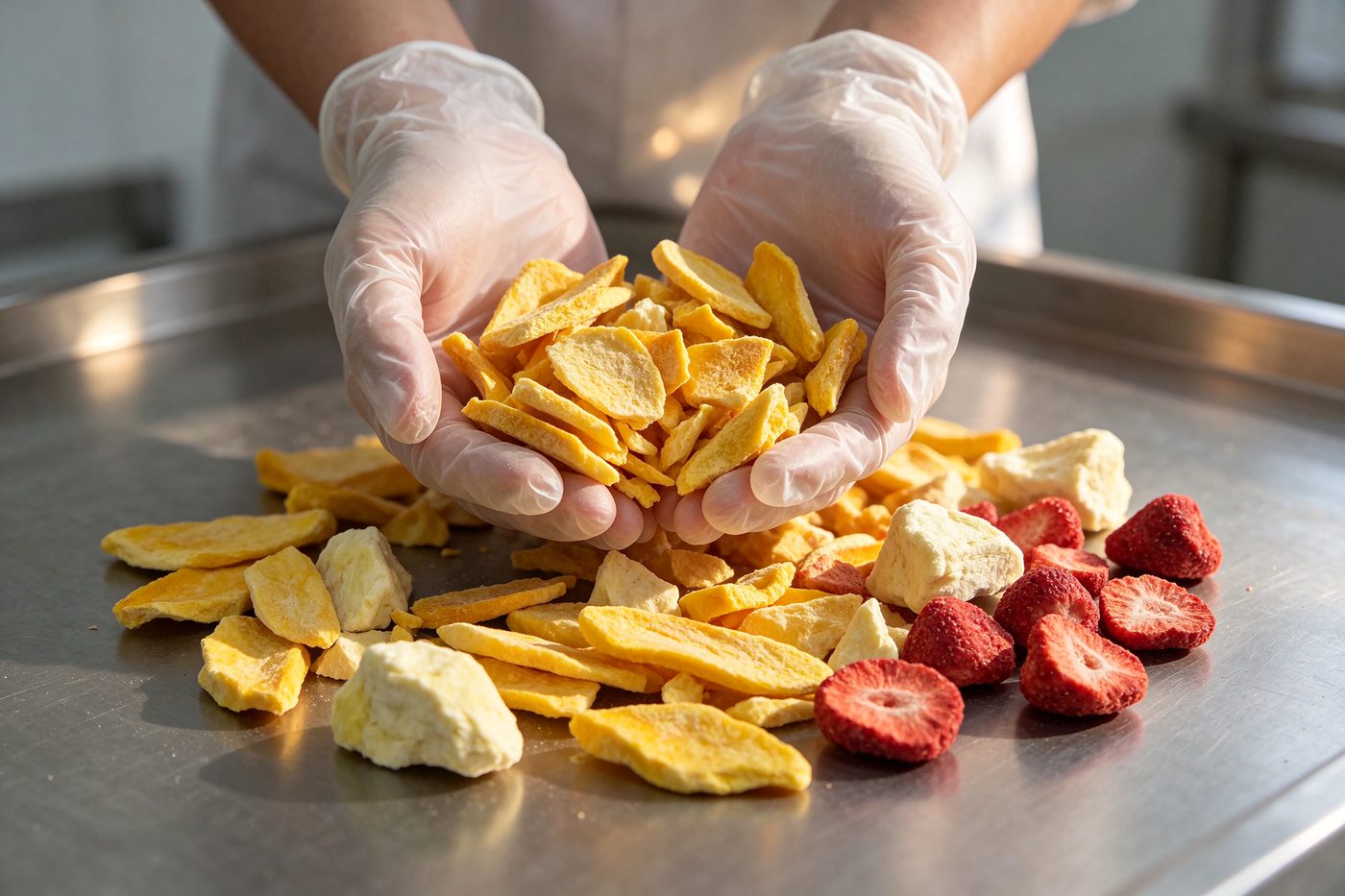
How freeze-drying removes the root cause
Freeze-drying — lyophilization, or FD — runs in three stages. Because the water never becomes liquid, it does not drag dissolved solids to the surface, and the cell structure stays largely intact.
01
Freeze
The product is frozen solid so the water becomes ice inside the food’s own structure.
Below −30°C, typically −30 to −40°C
02
Sublimate
Under vacuum, ice turns directly from solid to vapour. Shape, colour and aroma survive.
Chamber pressure 10–50 Pa
03
Desorb
Residual bound water is removed to reach the target moisture and water activity.
Residual moisture 1–3%, aw 0.08–0.33
What freeze-drying cannot do
It is a preservation step, not a sterilisation step. Setting expectations honestly is part of selling it well.
It does not make food sterile +
Pathogens present before processing can survive. Safe raw material, hygienic handling and validated process parameters are still required.
It does not protect itself +
A dry, porous product is hygroscopic by design. Exposed to Malaysian air it reabsorbs moisture quickly and aw climbs. Moisture-barrier packaging is part of the product, not an accessory.
Shelf life must be tested, not assumed +
The real figure depends on recipe, load, cycle and pack under the storage conditions you actually expect. “Two years” before a stability test is how brands end up with returns.
Some categories resist it +
Very high-fat items can still oxidise, dense pieces dry slowly and unevenly, and very wet or sugar-rich products need recipe adjustments.
It is not the cheapest route per kilogram +
Capital and energy per kilogram are higher than hot-air drying. The justification is quality, weight and shelf life — not unit cost.
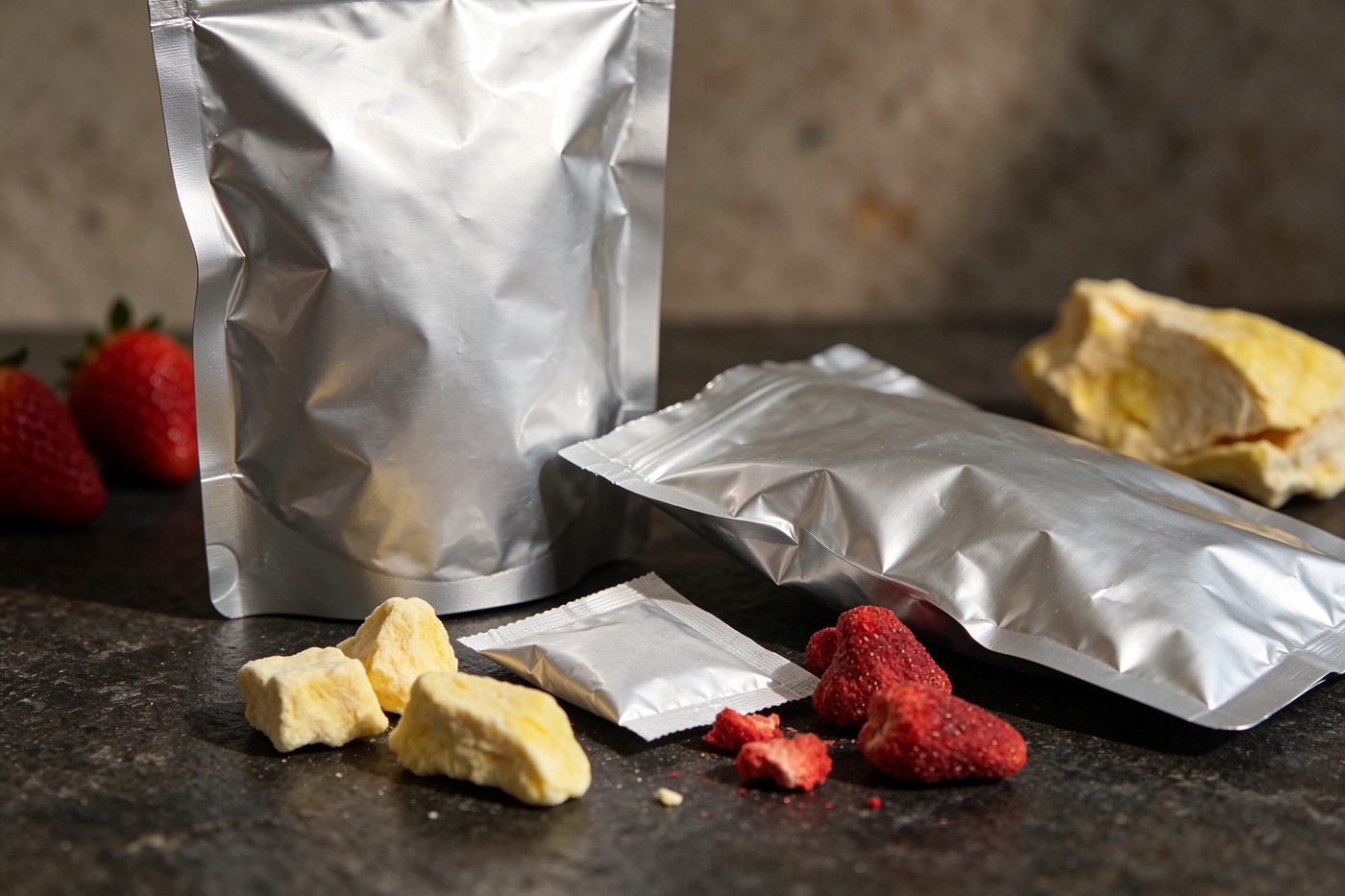
Barrier pouch plus oxygen absorber, where appropriate. The dryer sets water activity; the pack keeps it there.
Freeze-drying compared with other preservation routes
No single row wins everything. The right method hits your target texture, shelf life and cost per pack at the volume your buyers actually order.
Swipe sideways to read every column.
| Method | Process | Final water | Colour & aroma | Rehydration | Energy | Best fit |
|---|---|---|---|---|---|---|
| Freeze-dryinglyophilization, FD | Frozen, then sublimation under vacuum | 1–3% moisture aw 0.08–0.33 |
High retention | Excellent, fast | High | Premium snacks, fruit, instant meals, heat-sensitive actives |
| Hot-air dryingcabinet, tunnel | 50–80°C air | 5–15% | Noticeable loss, browning | Moderate | Low to moderate | Herbs, bulk ingredients, cost-driven lines |
| Spray drying | High inlet air temperature | 3–5% | Aroma volatiles partly lost | Good, powders only | Moderate | Liquid to powder: milk, coffee, juice, puree |
| Frozen storage | −18°C or lower | Unchanged | Good until freeze–thaw | Not applicable | Very high, continuous | Meat, seafood, short-window distribution |
| Retortcanning, ambient | 110–125°C | High | Significant heat damage | Not applicable | Moderate | Wet ready-to-eat products, long ambient life |
Figures are typical ranges for commercial equipment, not guarantees for a specific recipe. Confirm your own moisture and aw targets with a trial batch.
The commercial case for freeze-drying in Malaysia
Malaysia sits on raw material that is expensive to export fresh and valuable when it is light, stable and ambient.
Tropical fruit
Durian is the clearest case: premium, seasonal, heavily perishable, and a high-value ambient snack once freeze-dried. Mango, pineapple, jackfruit, banana and rambutan follow the same logic.
Herbs and aromatics
Lemongrass, pandan, torch ginger, kaffir lime leaf and pepper hold aroma far better than through hot air.
Seafood and prepared meals
Dried shrimp and fish, broth concentrates and instant meal components for retail, travel and institutional buyers.
Bakery and beverage inclusions
Fruit pieces and powders that stay crisp in cereal, chocolate and tea blends instead of softening in the pack.
Emergency and remote provisions
Lightweight, ambient-stable rations for marine, mining, plantation and disaster-response supply.
Export logistics
Lower product weight cuts freight and handling cost — relevant for a country shipping into Singapore, the Gulf, China, Japan and Europe.
Two numbers decide whether the model works — and neither is the machine price
≈ 1 : 3
High-moisture fruit typically yields around one-third of its fresh weight. Ten kilograms in, three out is a normal starting assumption — measure it rather than assume it.
Cost per pack
Raw material, usable yield, cycle time, energy, labour, packaging, compliance and wastage all sit inside that number. Equipment is one line of the model, not the model.
What a realistic freeze-drying pilot looks like
Eight steps that answer the commercial questions, not just the technical ones.
A pilot is not a product sample. It should produce a batch record you can defend to a buyer: yield per product, cycle time, energy and labour per batch, the pack you actually intend to sell, and a shelf-life checkpoint schedule.
01
Choose three to five products
Ones buyers have already shown interest in. Not ten.
02
Run measured batches
Record loading density, cycle time, chamber pressure, temperature profile, final moisture and aw.
03
Weigh fresh in, finished out
Every batch, every product. Yield is the first number that decides the business case.
04
Log energy and labour per batch
Convert to cost per kilogram, then cost per retail pack.
05
Pack in the real format
The pouch you intend to sell — then store it under realistic Malaysian conditions, not in an air-conditioned office.
06
Test shelf life at intervals
Texture, aw, colour, microbial status and sensory acceptance, at fixed checkpoints.
07
Take samples to buyers
Distributors and, where relevant, regulators — before committing to production capacity.
08
Size the machine to proven numbers
Proven cycle time and proven demand, not a brochure capacity table.
Where KEMOLO fits in the picture
The equipment is one part of the equation. The more attractive proposition is the ability to develop differentiated products — fruit snacks, bakery inclusions, instant meal components, travel foods and emergency provisions with a texture that supports premium positioning.
KEMOLO supplies freeze-drying equipment — industrial freeze dryers and lyophilizers — across pilot and production-scale capacities. What we deliberately do not publish is a single headline price, because there is no meaningful one: freeze dryer cost depends on batch capacity, refrigeration and vacuum design, control system, tray area, materials, included accessories, certification documentation, installation scope and trade term. Quotations built on different configurations are not comparable.
Send your product list, target pack size and expected monthly volume, and ask for a configuration proposal with an itemised cost breakdown and a pilot trial on your own raw material.
Before you commit budget, confirm in writing
Specification and rated capacity for the model; what is included (trays, trolleys, vacuum pump, control package, spares); installation, commissioning and training; certification and compliance documents for your market; lead time, Incoterms and shipping cost to your port.
The honest starting question
Not “what does a machine cost?”, but:
“Here are my products, my target pack, my volume and my buyer — what configuration gets me there, and what does the whole line cost per pack?”
A pilot batch on your own raw material tells you more about yield, texture and shelf life than any specification sheet.
Frequently asked questions
Short answers for the questions buyers ask first.
How long does freeze-dried food last in Malaysia's humidity?+
In retail moisture-barrier pouches, 12–24 months is a realistic range for many products, provided the pack is sealed and water activity stays low. High-barrier bulk storage with oxygen absorbers can hold quality considerably longer. The reliable figure comes from a stability test on your own recipe and pack.
Does freeze-drying kill bacteria and mould?+
No. It removes the water microorganisms need in order to grow, but it is not a sterilisation process. Organisms present before drying can survive, so raw-material quality, hygiene and validated process parameters remain essential.
Can durian and other tropical fruit be freeze-dried in Malaysia?+
Yes. High-moisture tropical fruit needs recipe and loading adjustments compared with temperate fruit, and yield is typically around one-third of fresh weight, so raw-material cost dominates the model. A trial batch on your own variety is the fastest way to confirm texture, aroma and yield.
Freeze dryer or dehydrator: which is better for a humid climate?+
A dehydrator is cheaper and faster per kilogram, but heat darkens colour, flattens aroma and produces a denser texture. Freeze-drying preserves shape, colour and aroma and rehydrates quickly. In a humid market the deciding factor is usually final water activity and the barrier packaging both methods still require.
How much does a commercial freeze dryer cost?+
There is no single figure. Price depends on batch capacity, refrigeration and vacuum specification, controls, materials, accessories, certification and trade term. Compare itemised quotations for the same capacity class and include installation, freight and spares in the total project cost.
Do I still need oxygen absorbers and desiccant after freeze-drying?+
Often yes. Desiccant manages residual headspace moisture, while an oxygen absorber slows oxidation and protects colour and aroma, especially in high-fat products. The correct combination depends on the product and film barrier and should be validated during the shelf-life test.
Is freeze-dried food suitable for export?+
Generally yes. Low weight, no cold chain and long ambient stability suit export logistics. You still need correct labelling, country-specific compliance, a validated shelf-life claim and packaging that survives transit humidity.

