

Technical dossier — food & pharma lyophilization
Freeze-drying doesn’t add health. It stops subtracting it.
Inside a commercial lyophilizer, water leaves as vapour at −40 °C and deep vacuum — below the triple point, so nothing boils, nothing caramelises, and almost nothing oxidises. What you keep is what the raw material already had.
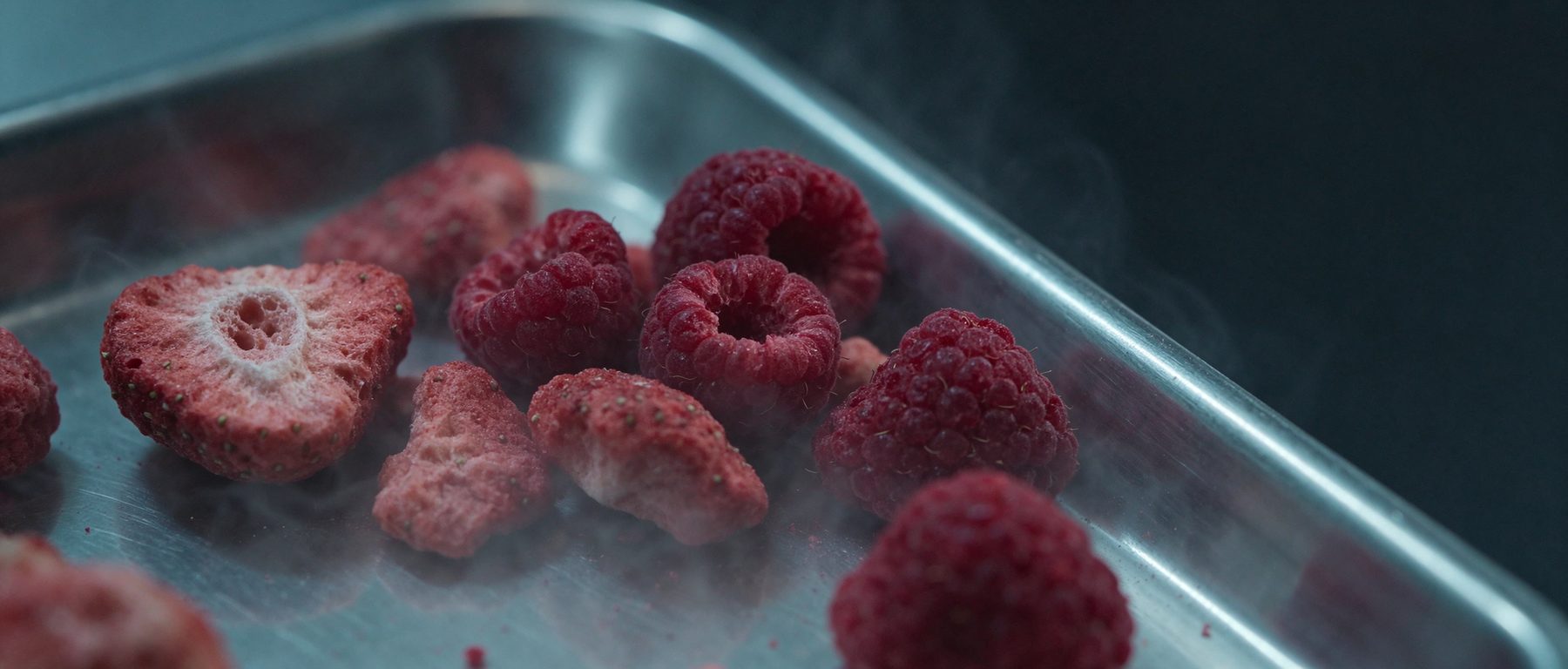
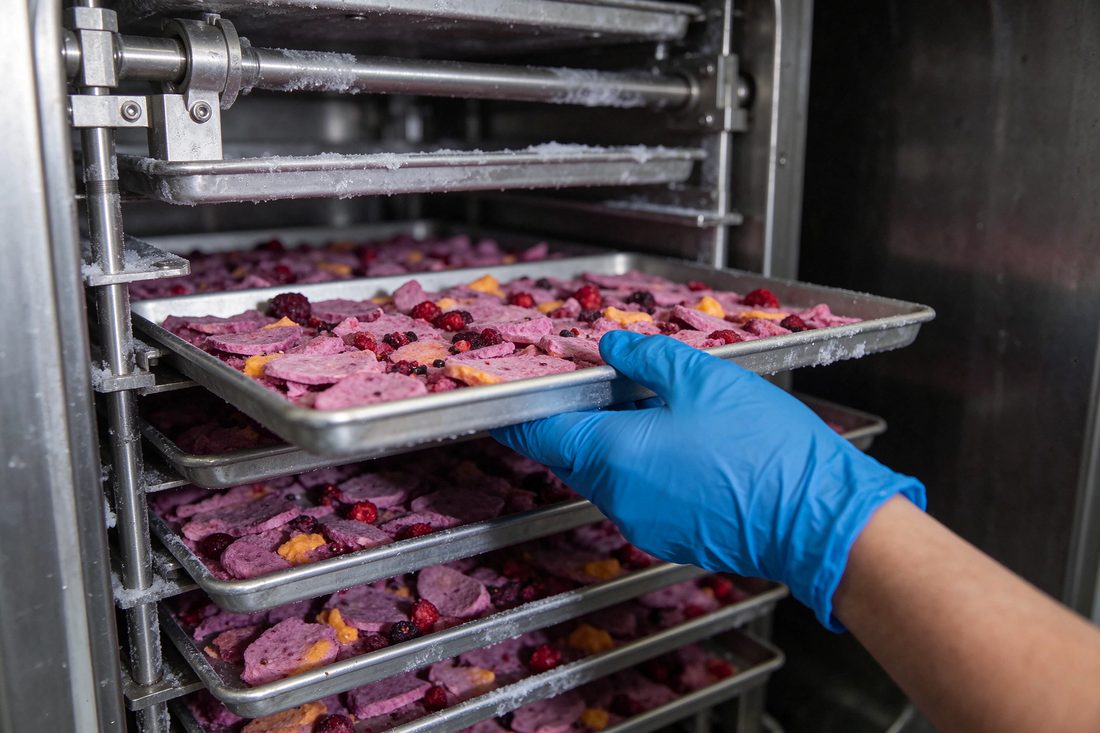
Sublimated raspberry and strawberry pieces on a stainless tray — porous structure is the water’s exit path, frozen in place.
99.58%
Vitamin C retained in freeze-dried jujube
<1%
Anthocyanin loss, purple mulberry
90–97%
Probiotic survival with protective matrix
5,000kg
Largest single industrial batch capacity
01 — Nutrition
The honest claim is preservation, not enhancement.
A lyophilizer is not a nutraceutical. It removes water — and it avoids removing almost everything else. That argument only lands when the freeze-dried product replaces something worse.
Freeze-drying strips 85–95% of the water weight without ever letting the product rise above freezing. Nothing is fortified and nothing is transformed: the claim is simply that the vitamin C, the anthocyanins and the aromatics that heat would have taken are still there once the water is gone.
So freeze-dried fruit is a substitution story, not a supplement story. A clean-label freeze-dried snack competes on the shelf with biscuits, potato chips and fried fruit chips — categories where the fat line, not the vitamin line, decides the nutrition panel.
Apple shows the gap most plainly. A raw apple carries roughly 0.2% fat. Run it through a fryer and the chip passes 34% fat. Freeze-dried, the same fruit carries zero added fat: the water leaves, the fat number does not move.
WHAT THE PROCESS CANNOT DO
Add a nutrient that was never in the raw material · rescue a poor lot · compensate for skipped blanching. Preservation protects what you already bought; it does not upgrade it.
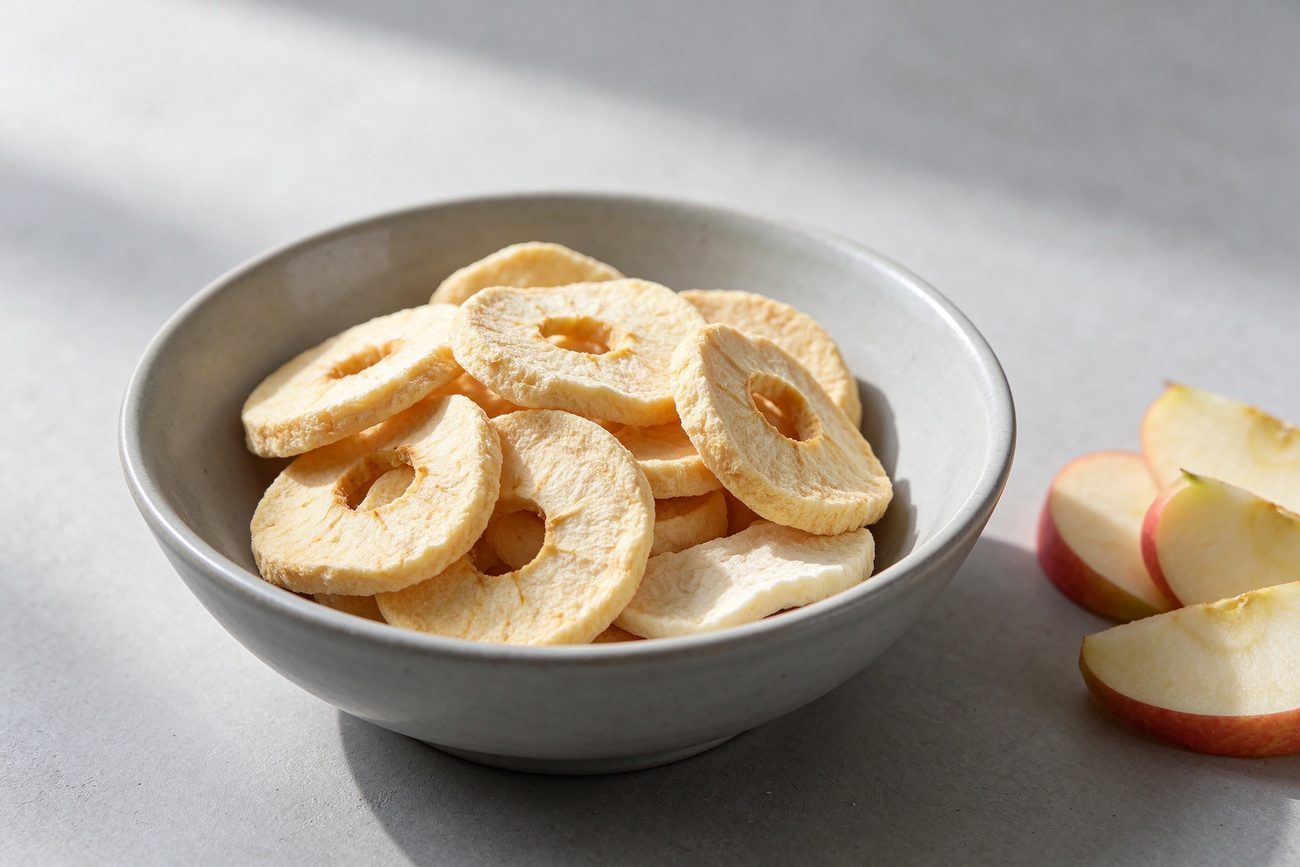
Fat per 100 g · apple
One fruit, three processes
Raw appleunprocessed
0.2%
Deep-fried chipsoil-contact frying
34%+
Freeze-driedsublimation only
0%
Fat arrives through the frying medium; it cannot arrive through a vacuum chamber, because no fat enters it. Removing water raises nutrient density per 100 g — it does not raise fat.
| Instead of | Freeze-dried alternative | What actually changes |
|---|---|---|
| Fried fruit chips · 34%+ fat | Freeze-dried apple & banana rings · 0% added fat | Crispness comes from the frozen ice lattice, not from oil. Fat per 100 g collapses from 34 g toward zero added fat. |
| Candied fruit · syrup-preserved | Freeze-dried fruit pieces · no syrup load | No sugar bath, so vitamin C survives instead of being boiled out, and the panel loses the added-sugar line entirely. |
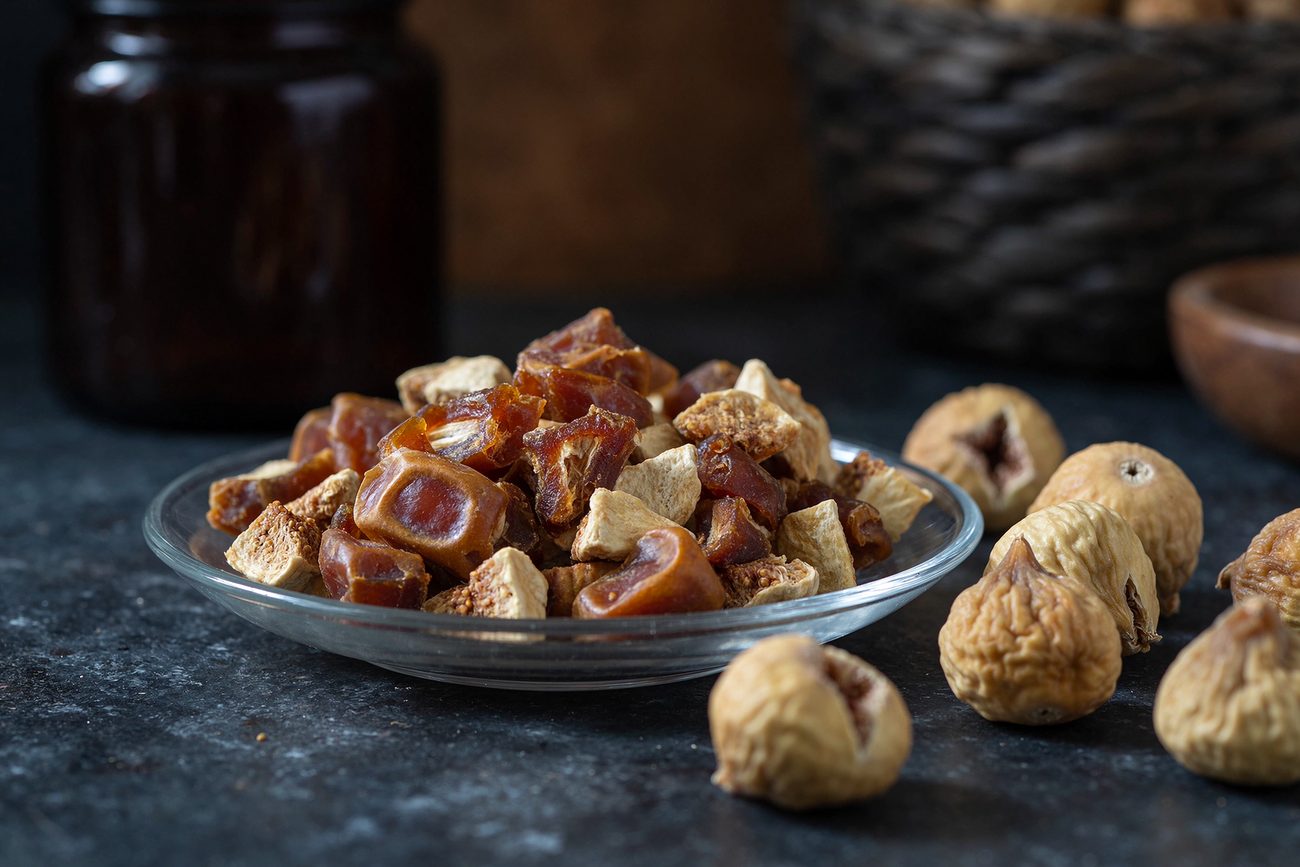
| Spray-dried instant coffee · flat top notes | Freeze-dried instant coffee · whole aroma | >95% of key volatiles — limonene, linalool, β-damascenone — stay in the powder instead of leaving with the drying gas. |
02 — Retention kinetics
Where the numbers actually come from.
Freezing locks the structure; vacuum lets the ice leave without ever becoming liquid. Ascorbic acid, anthocyanins and volatile aromatics are never exposed to the temperatures that destroy them — that is the whole mechanism.
Schematic water phase diagram, logarithmic pressure axis. The route avoids the liquid region entirely — which is why nothing boils, caramelises or oxidises in the chamber. On phones the diagram scrolls sideways.
01
Load at ambient
Fresh or blanched product enters the chamber at +20 °C and 1 atm. Cut size and load density are fixed here; they decide how evenly the ice front retreats later.
02
Freeze to −30 … −50 °C
Water becomes ice in place. The cell walls, the pores and the pigment positions are locked into a solid lattice — the structure that heat would have collapsed is now frozen.
03
Evacuate below 611 Pa
Pressure falls under the triple point. Ice can no longer melt: at this pressure the only exit for water is the vapour phase. This is the line that separates freeze-drying from every hot process.
04
Sublimate to the condenser
Heat is fed through the shelves at low temperature; vapour moves to a condenser held at −45 °C and deposits as ice. No boiling, no oil, no drying gas carrying the aroma away.
| Component | Lyophilizer · empirical result | Conventional method | Retention |
|---|---|---|---|
| Vitamin Cjujube · hawthorn · spinach | Jujube retains 99.58% of its vitamin C. Freeze-dried hawthorn reaches 60.27 mg/100 g, 6.6× sun-dried. Spinach holds ≈93%. | Boiling, syrup-preserving and candying destroy effectively all of it. |
99.58%
|
| Polyphenols & anthocyaninspurple mulberry · green wheat | Purple mulberry loses <1% anthocyanin. Green wheat total flavonoids reach 1.965%, against 1.216% for hot-air drying; phenols, flavonoids, chlorogenic acid and rutin all peak. | Hot-air drying: 1.216% flavonoids — oxygen plus sustained heat oxidises the polyphenol fraction. |
>99%
|
| Aroma & carotenoidsinstant coffee | Freeze-dried instant coffee keeps >95% of its key volatile aromatics — limonene, linalool, β-damascenone — so the cup still reads as coffee, not as powder. | Spray drying volatilises the top notes into the drying gas; the profile flattens. |
>95%
|
| Minerals · fibre · proteinall matrices | Fully preserved and concentrated: they are non-volatile and pass through the cycle unchanged, so their share of the finished mass rises as water leaves. | High-heat convection drying degrades structure and can drive Maillard browning. |
NO THERMAL LOSS concentration only
|
| Probiotic viabilityprotected matrix | With trehalose, hyaluronic acid or whey-protein protection, survival reaches 90–97.13% of the live cultures. | Spray drying leaves ≈0.20% survival — the cultures are effectively eradicated. |
90–97%
|
How to read this table. Every figure is a reported value from a named matrix, not a blended average across products — a jujube result is not an apple result. Where the source gives a ratio (6.6× sun-dried hawthorn), no absolute baseline has been reverse-engineered here.
Where the numbers do not hold. Retention is a function of raw material quality, cut size, load density and cycle profile. A lyophilizer run on a badly profiled cycle can lose more vitamin C than a well-run hot-air dryer, and pre-treatment — peeling, blanching, sulfiting — moves the result more than the machine choice does.
A — HOT AIR
Oxygen plus sustained heat
Polyphenols oxidise, sugars caramelise, colour darkens. Cheap and fast, and the flavonoids in green wheat land at 1.216% against 1.965% freeze-dried.
B — SPRAY DRYING
Atomised into a hot gas stream
Excellent for powder economics, brutal on anything alive. Live cultures fall to roughly 0.20% survival, and the volatile top notes leave with the exhaust.
C — BOILING / CANDYING
Water-soluble, heat-labile
Ascorbic acid is both: the syrup bath and the boil take the vitamin and leave the sugar. This is the one method where vitamin C is practically zeroed out.
03 — Halal compatibility
The machine adds nothing. That is the whole argument.
Halal status is decided by what enters the chamber and what touches the product between steps — not by the phase change itself. Understanding that split is what separates a certification project from a marketing claim.
Halal — permissible — is governed by three things in a food operation: the origin of the raw materials, the purity of the processing aids, and the prevention of cross-contamination. A lyophilizer touches none of the three.
Inside the chamber the only inputs are heat and a pressure drop. No solvent, no carrier gas, no release agent, no frying medium. Water leaves as vapour and is collected as ice on a condenser held near −45 °C. Physically, the process introduces no non-Halal risk at all — which is why freeze-drying equipment presents zero barrier to certification.
Zero barrier is not the same as certified. The certificate follows the inputs: gelatine or pepsin in a carrier, an alcohol-based cleaning solvent, a shared line with a non-Halal product. Those are procurement and protocol problems, and they are resolved before the machine is switched on.
GATE 01
Raw materials of animal or biological origin
The question that decides most audits: what is the carrier, and where did it come from?
- Gelatine, pepsin, enzymes, dairy or flavour carriers — each with a certificate of origin and a recognised Halal certificate, not a supplier email.
- Probiotic and enzyme strains are checked on the growth medium, which is where hidden animal-derived media usually sit.
GATE 02
Processing aids and cleaning chemistry
The chamber itself is clean; the cleaning agent is the risk.
- No alcohol-based or non-Halal sanitisers on food-contact surfaces; CIP chemistry declared and documented.
- Rinsing validated — residue of a cleaning agent counts as an input under Halal law.
GATE 03
Line separation and cross-contamination
Shared equipment is permitted; shared residue is not.
- Dedicated trays and racks, or a validated changeover between Halal and non-Halal campaigns.
- Batch records that let an auditor trace one tray from raw-material lot to sealed pouch.
THE EQUIPMENT’S PART — AND ITS LIMIT
Sanitary SUS304/316L chamber, cleanable and drainable; heat delivered by shelf contact under vacuum, not by a combustion air stream; tray-level records that survive an audit. What it cannot do: certify the raw material that enters it.
PHYSICAL PROCESS
VERDICT
VERDICT
No barrier in the chamber. The entire Halal risk sits in documentation, cleaning chemistry and line discipline — all of which are settled before a single tray is loaded.
04 — Equipment
From a 1 kg bench unit to a 5,000 kg line.
The physics does not change with scale; the tray area, the condenser load and the vapour path do. KEMOLO has built freeze-drying systems — and nothing else — for more than 20 years, across food and sterile pharmaceutical production.
1kg
Laboratory & sample unit
Cycle development, formulation screening, and the sample batches a buyer asks for before signing a volume contract.
Custom
Pilot-to-production bridge
Sized between the bench unit and the industrial line: shelf spacing, tray count and ice-condenser capacity matched to your load profile.
5,000kg
Industrial batch system
5-tonne chambers for fruit, coffee, probiotics and prepared-meal components — the capacity that turns a freeze-dried line into an export business.
PHARMA
BRANCH
BRANCH
Sterile pharmaceutical lyophilizers. Same engineering group, separate design and validation regime — aseptic loading, CIP/SIP, and documentation packages built for regulated markets rather than for food retail.
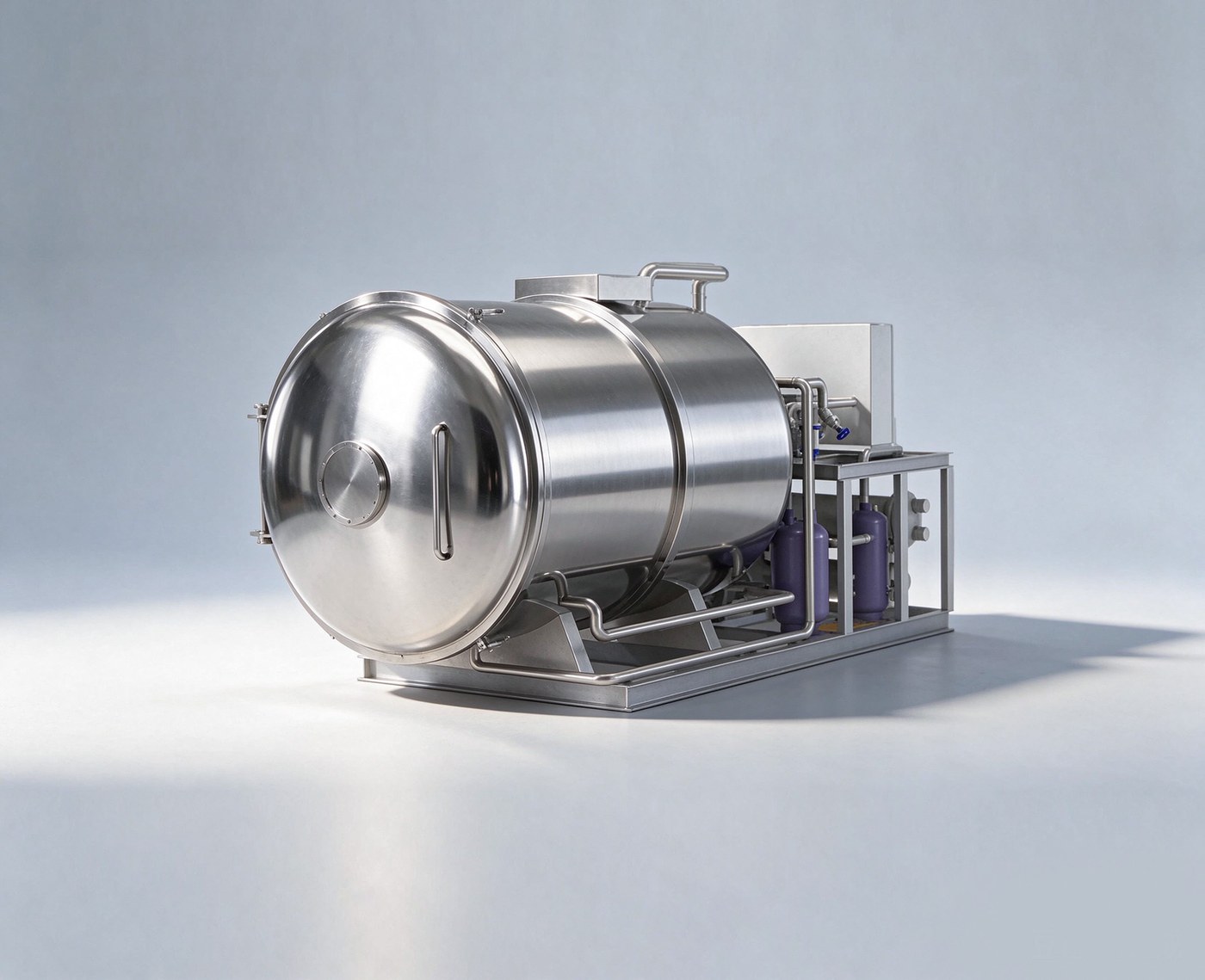
Chamber SUS304 / SUS316L Working vacuum 10–50 Pa Shelf freezing −30 … −50 °C Food-grade & sterile pharma Capacity 1 kg → 5,000 kg Focus freeze-drying only, 20+ years
05 — Questions buyers ask
The five questions that decide the purchase.
Short answers, with the number that backs each one. If a supplier answers these from memory rather than from a test report, treat the rest of the quotation the same way.
Are freeze-dried products actually healthy?
They are not fortified — they are preserved. Freeze-drying removes 85–95% of water without taking the product above freezing, so heat-sensitive vitamins, polyphenols and aromatics stay close to their raw values. The health value is positional: freeze-dried fruit with zero added fat replaces deep-fried chips at 34% fat. Two caveats belong in the same sentence — water removal raises calorie density per 100 g, so portion control still governs, and none of this constitutes a medical or nutritional claim.
Does freeze-drying destroy nutrients?
Thermal degradation is largely eliminated, because sublimation runs at −30 to −50 °C under deep vacuum. Reported figures: 99.58% vitamin C retention in jujube, 60.27 mg/100 g in freeze-dried hawthorn (6.6× sun-dried), roughly 93% in spinach, under 1% anthocyanin loss in purple mulberry, and over 95% of key coffee aroma volatiles. What still costs you: raw-material quality, pre-treatment (peeling, blanching, sulfiting) and a badly profiled cycle.
Is freeze-dried food Halal?
The process is: no solvent, no processing aid and no heat-transfer medium enters the chamber, so the equipment presents no barrier to Halal compliance. The product is Halal only when its inputs are — raw materials, carriers, cleaning chemistry and line changeover — and when an accredited body has certified that chain. Ask the supplier for the certificate scope, not the logo.
How much does a commercial lyophilizer cost?
Price follows batch capacity, tray area, ice-condenser load, vacuum class, refrigeration, automation and chamber material (SUS304 or SUS316L). A 1 kg laboratory unit and a 5,000 kg industrial line sit orders of magnitude apart, which is why no responsible quotation starts from a number. Send batch size, product form, target residual moisture and required cycle time; the price follows from those four, plus utilities and site conditions.
How much capacity do I need to start?
Work backwards from fresh throughput. At 85–90% raw moisture, roughly 7–10 kg of fresh fruit yields 1 kg of finished freeze-dried product. A 100 kg fresh-fruit day therefore needs about 10–14 kg of finished capacity per cycle — before cycle length (typically 20–40 h) and loading density are applied. That rule of thumb is an estimate, not a specification: your product's moisture curve decides the real number.
06 — Inquiry
Send the load profile. We send back a cycle.
Equipment sizing is arithmetic, not salesmanship: product form, batch mass, target residual moisture, market. Give us those four and the proposal stops being a brochure.
