


Freeze dryer installation and commissioning in Vietnam
Yes — we send engineers. For FD series industrial freeze dryers with a capacity of 500 kg and above, Kayolo dispatches one to two engineers to your site in Vietnam, at your request, to guide installation and maintenance and to train your operators. HL series economical freeze dryers and models under 500 kg are all-in-one units: they need no installation or commissioning and can run as soon as they arrive.
20+years building commercial and industrial lyophilizers
500 kgcapacity threshold that triggers an engineer visit
80%of reported issues traced to parameter settings, solved online
Quick answer
Service ruleCan a Kayolo engineer come to my factory in Vietnam?Updated Nov 2026
FD series, 500 kg capacity and aboveYes. One to two engineers can be assigned to your site at your request for installation, commissioning, maintenance guidance and operator training.
HL series and units below 500 kgNo installation is needed. These are all-in-one machines, ready to use once received and connected to power and water, so engineers normally do not need to travel.
Any alarm or abnormal resultSend photos and short videos first. Over 80% of issues are parameter-related and can be corrected remotely, without waiting for a service visit.
Which models need an engineer on site?
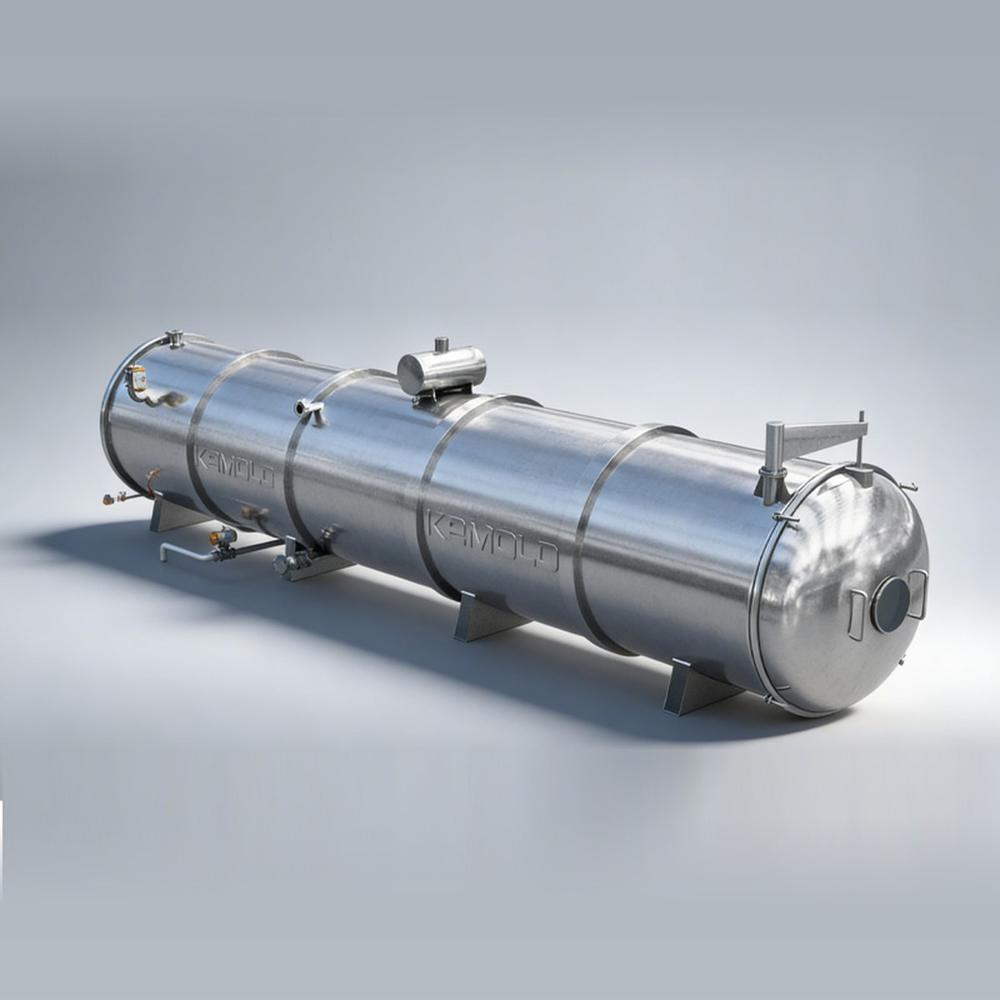
Model rulesThe rule is simple and capacity-based. Large FD series vacuum freeze dryers are built as split systems: shelves, cold trap, refrigeration unit and control cabinet are assembled and wired on site. HL series economical freeze dryers are packaged as single skid units with a closed refrigeration circuit, tested at the factory before shipment.
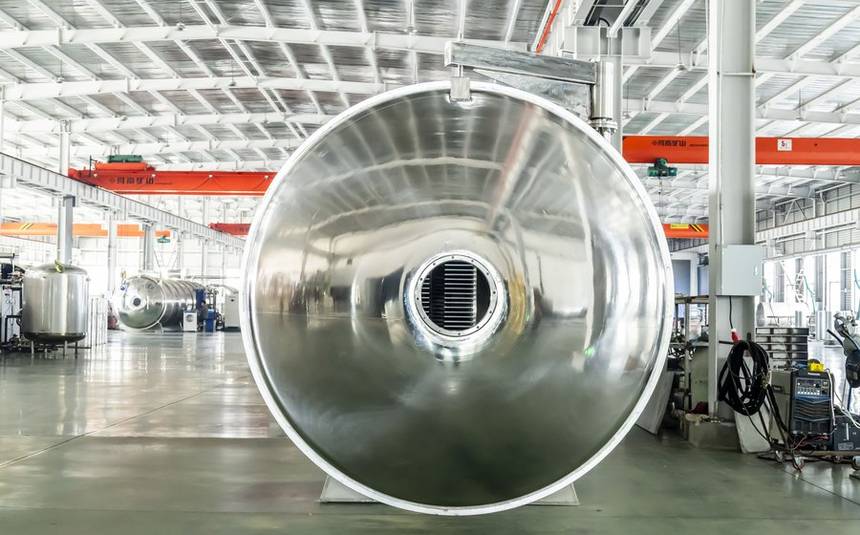
FD series — industrial freeze dryer
Split system · installation and commissioning required
Typical capacity500 kg and above
InstallationAssembly, wiring, vacuum test, start-up
Engineer visit1–2 engineers on your request
On-site timeTypically 3–7 working days, confirmed per project
Operator trainingFace to face, on your own machine
Typical buyersFruit and vegetable lines, herbs and medicinal materials, seafood, pet food, probiotics
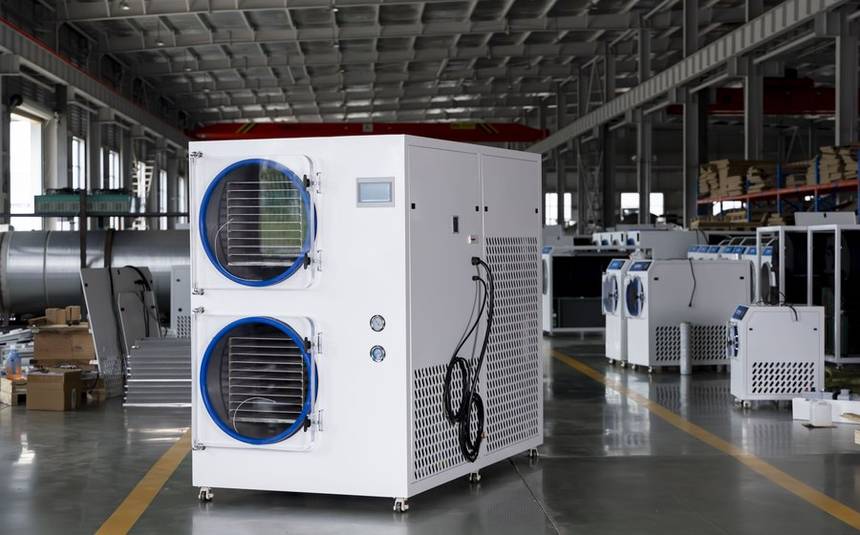
HL series — economical freeze dryer
All-in-one · plug and play
Typical capacity500 kg and below
InstallationNone — connect power and water only
Engineer visitGenerally not required
On-site timeNone; video walkthrough on request
Operator trainingRemote video session, English manual and recipe sheet
Typical buyersStart-up farms, pilot batches, small factories, retail and sample production
Check your capacity against the rule
Select the batch capacity you plan to run per cycle. The answer follows the same threshold we use for service planning.
Pick a capacity to see the service route
HL series is all-in-one up to 500 kg per cycle; FD series above that is commissioned by our engineers on site.
What the engineers actually do on site
Six hand-over stepsCommissioning an FD series line is a sequence, not a single moment on the day the crate is opened. Each step is signed off before the next one starts, and the machine is only handed over after a complete drying cycle has run on your own product.
01
Utility and site verification
Confirm three-phase power rating, water supply, compressed air, drainage and floor loading before unpacking, and agree the final layout with your technical contact.
02
Unpacking, positioning and levelling
Check the crate and accessories against the packing list, move the unit into place, level the frame and tighten the chamber and piping connections.
03
Vacuum leak test
Pull the empty chamber down and hold it, verify it reaches the working vacuum range of 10–50 Pa, and correct any leak at door seals, flanges or valve seats.
04
Refrigeration and cold trap start-up
Check refrigerant charge, cold trap pull-down, defrost cycle and condenser behaviour, then record compressor running parameters in the commissioning log.
05
Recipe and parameter setting
Build the drying curve for your product: loading rate, shelf temperature, vacuum set-point, heating rate and cycle time, saved as a named program on the controller.
06
Trial production, training and handover
Run one full cycle with your material, train your operators on loading, defrost, cleaning and alarm handling, and leave with a written commissioning report and spare-parts list.
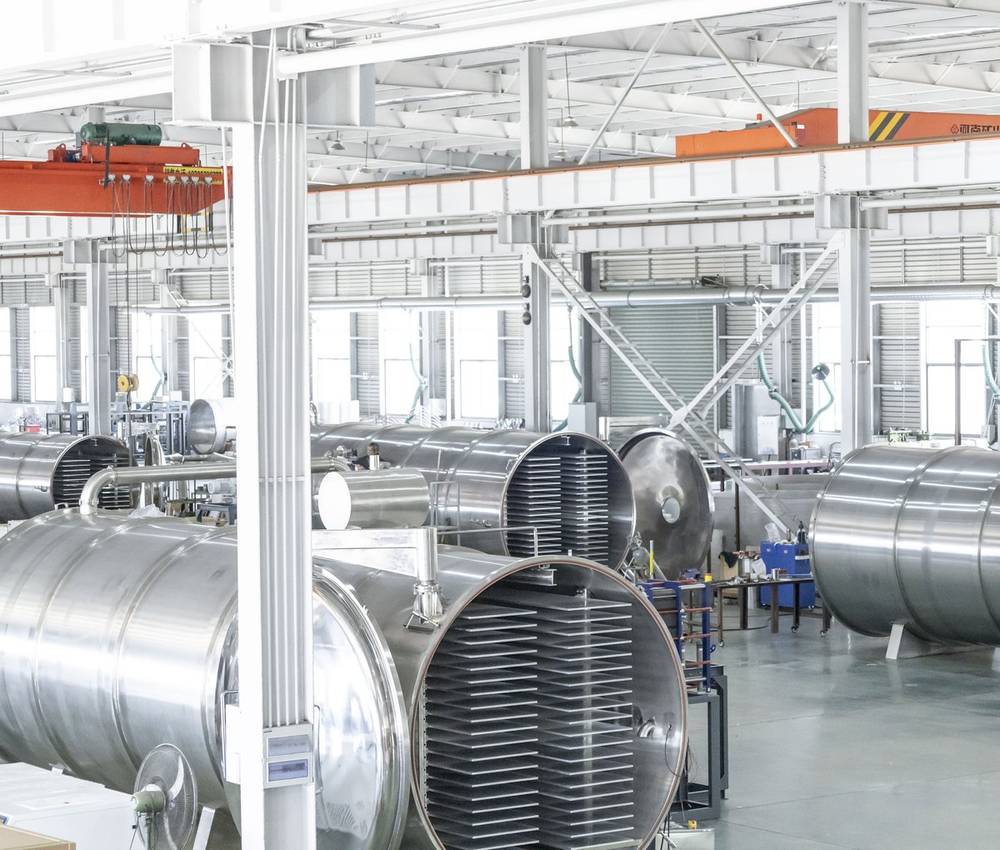
Door open, shelves in place: the shelf, seal and vacuum check is the same sequence the engineers sign off on your site.
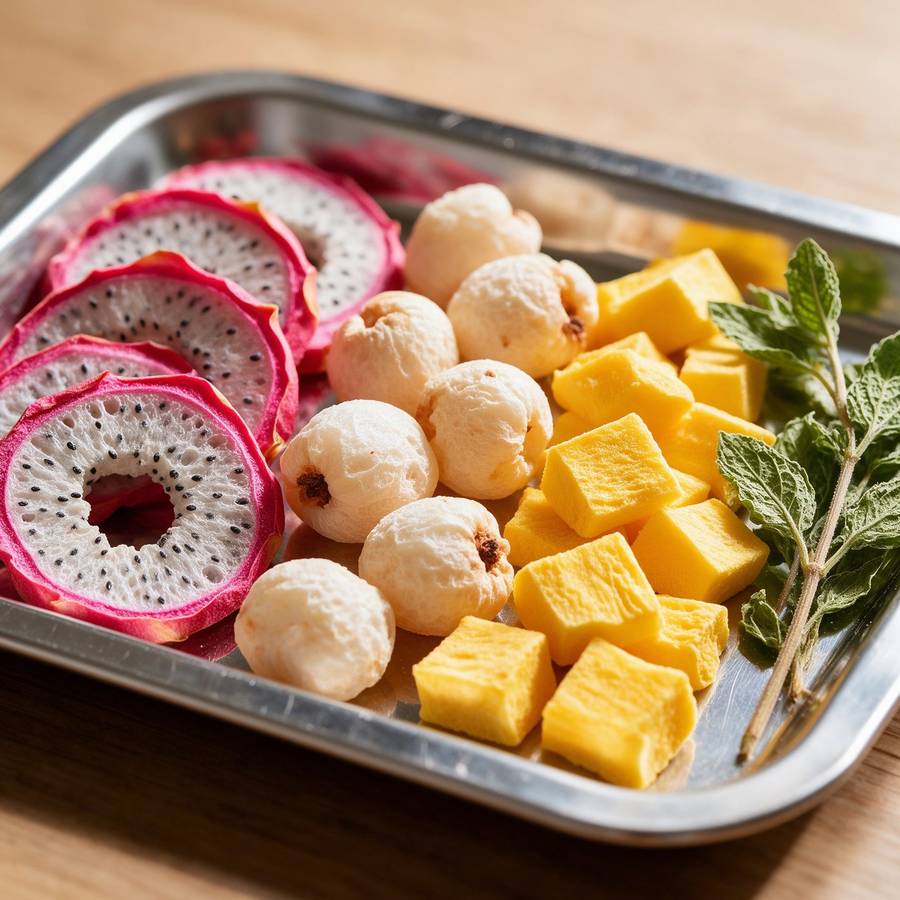
The outcome we sign off on
A correctly commissioned machine produces batches with uniform porosity, retained colour and aroma, and final moisture inside the range your product specification requires — often 2–5%. If the first trial cycle misses that target, the recipe is adjusted and re-run before the engineers leave, not deferred to a later visit.
Remote support: why an engineer visit is often unnecessary
Online firstBased on more than 20 years of field experience, over 80% of reported problems are caused by parameter settings rather than hardware failure. In those cases no engineer needs to fly in: the fix is a few set-points, done by your own operator while we watch the screen with you.
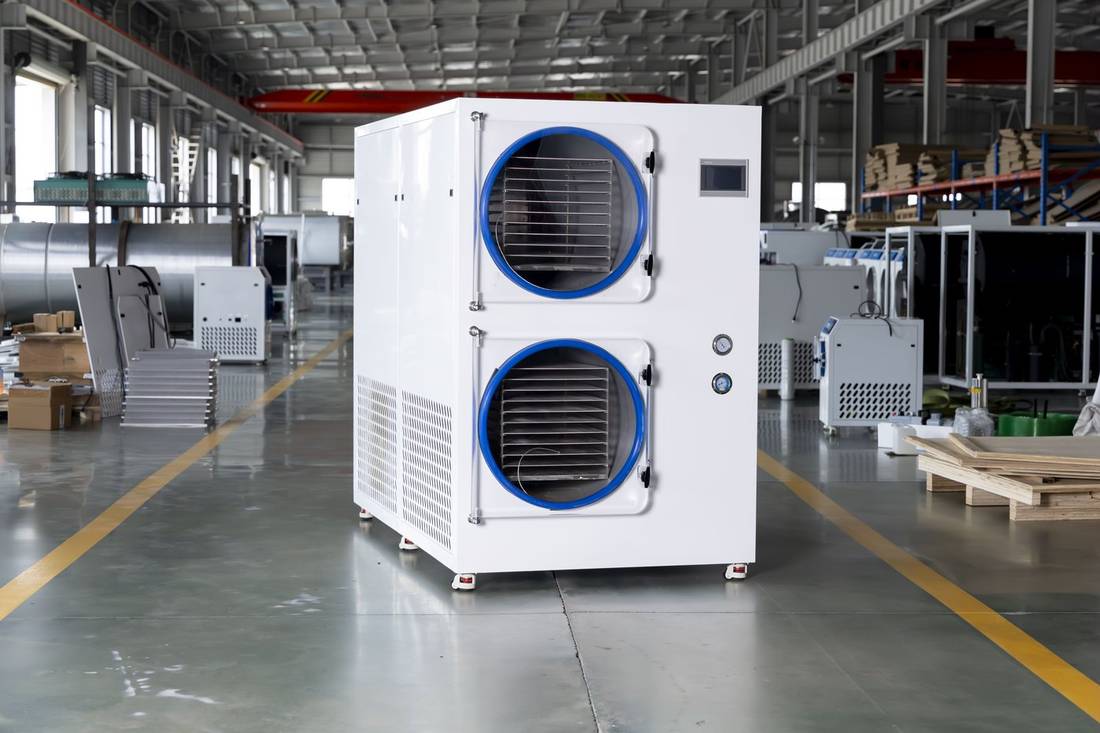
HL-100 twin-chamber unit: connect power and water, load the shelves, and the first batch can run the same day.
Step 01
Send the evidence
Photos of the HMI screen and alarm code, plus a 30-second video of the cycle and a picture of the product at the moment of the problem.
Step 02
Identify the specific issue
We compare your readings with the commissioning log — vacuum level, shelf temperature, condenser temperature and cycle stage — and name the parameter that is out of range.
Step 03
Adjust and verify
You change the setting yourself following our guidance, then send the next cycle result so we can confirm the batch is back inside specification.
Genuine hardware faults — a leaking seal, a failed sensor, a compressor trip — are handled separately: spare parts with clear replacement instructions, and a return visit when the machine cannot be restored remotely.
Where we travel in Vietnam
CoverageMachines for Vietnam usually arrive through Cát Lái in Hồ Chí Minh City, Hải Phòng in the north or Đà Nẵng in the centre. Engineer visits are planned around that delivery point, so the installation schedule starts from the port that clears your shipment.
Hồ Chí Minh CityCát Lái port gateway
Bình DươngIndustrial zones, food processing
Đồng NaiFruit and nut processing
Hà NộiHerbal and pharmaceutical
Bắc NinhFood and agricultural products
Hải PhòngPort gateway, northern plants
Đà NẵngCentral region, seafood
Cần ThơMekong Delta fruit
Planning notes for a Vietnamese plant
Before the orderThree local conditions shape the specification more than the brochure does. They are worth settling while the model is still being chosen, not after the crate has cleared customs.
Note 01
Humidity and condenser load
Wet-season ambient humidity and 30–35 °C daytime temperatures raise the load on the condenser. Sizing, cooling water temperature and the position of the drying room should be planned together, not left to the installation week.
Note 02
Power supply
Industrial sites in Vietnam commonly run 380 V three-phase at 50 Hz. Send us your panel nameplate before shipment so the heaters, motors and control transformer are configured for the supply you actually have.
Note 03
Consumables and spare parts
Door seals, vacuum pump oil, filter elements and temperature sensors are the items that stop a line. Stocking one set locally costs far less than a week of downtime while a parcel clears customs.
What to prepare before the engineers arrive
Site checklistMost installation delays are site-side, not machine-side. Six items settle the week before the flight is booked.
Power and earthing data
Voltage, phase count, breaker rating and earthing arrangement — send the nameplate photo of your main panel.
Water, air and drainage
Supply pressure and quality for the defrost and vacuum systems, plus a drainage route that can take hot water during defrost.
Access and floor space
Crate dimensions against door width, forklift capacity, and free space for shelf loading and service access.
Product samples and targets
At least two full batches of the real material, with target final moisture and the texture or colour standard you sell against.
One technical contact
A single English-speaking coordinator who can decide layout and sign the handover report during the visit.
Site safety rules
Permits, PPE requirements and working hours, so the engineer's schedule matches how your plant actually runs.
Frequently asked questions
Vietnam buyersDo you send engineers to Vietnam for installation and commissioning?
Yes. For FD series industrial freeze dryers with a capacity of 500 kg and above, one to two engineers can be assigned to your site at your request to guide installation and maintenance and to train your team. HL series and units under 500 kg need no installation at all.
How long does FD series commissioning take?
Typically three to seven working days on site, depending on the number of chambers, how ready the utilities are and how many product trials you want. The exact schedule is fixed in the sales contract before production starts; unfinished power or water connections are the most common reason a plan slips.
My capacity is below 500 kg. Do I still need a service visit?
No. HL series machines are all-in-one units, factory-tested and ready to use as soon as they arrive and are connected to power and water. A video walkthrough covers loading, defrost, cleaning and alarms. A visit can still be arranged on request, but it is normally unnecessary.
Are travel and accommodation costs included in the machine price?
The installation scope, engineer travel, accommodation and visa arrangements are all stated in the quotation, so the total cost is known before you place the order and there is no second invoice after the visit.
What happens if a fault appears after the engineers leave?
Send photos of the screen and alarm code plus a short video of the cycle. Over 80% of issues are parameter-related and are resolved with guided adjustments. Genuine hardware faults are handled with spare parts and, when necessary, a return visit.
What language is the training delivered in?
Training and documentation are in English. We recommend nominating one English-speaking coordinator on your side for the visit; a Vietnamese-language walkthrough can be discussed when the order is confirmed.
How much does an industrial freeze dryer cost in Vietnam?
Price depends on capacity, tray area, stainless grade (SS304 or SS316L) and refrigeration configuration. We quote FOB or CIF to Cát Lái, Hải Phòng or Đà Nẵng, with the installation option priced separately so the two can be compared directly.
Send your product, capacity and site city
We will come back with a model recommendation, an FOB or CIF price for Vietnam, and an installation plan that says clearly whether an engineer visit is needed — or not.
Request installation plan and price
