

Freeze Dried vs Dehydrated Fruit
Every question a buyer, product developer or plant engineer asks about the two routes: how they work, what survives, what it costs, and which fruit belongs in which machine.
drying principlesublimation
freezing temp−40 °C
chamber vacuum10–50 Pa
final moisture1–5%
water activity< 0.30
energy per kg water2.5–4.5 kWh
retail multiple4–6×
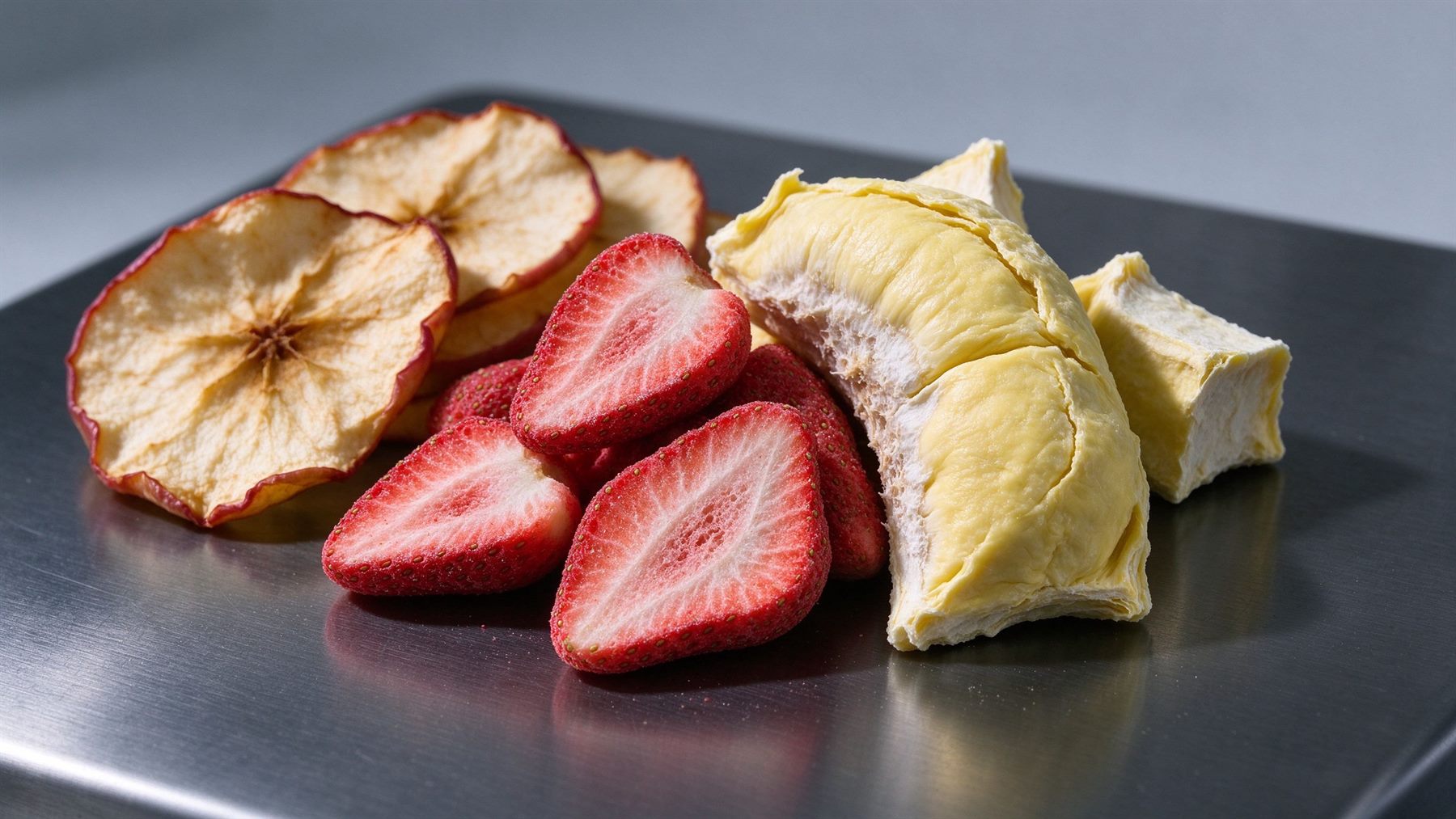
the short version
Dehydrated fruit is dried by heat. Freeze-dried fruit is dried by sublimation: the fruit is frozen to about −40 °C, the chamber is pulled to 10–50 Pa, and the ice turns straight into vapour without ever becoming liquid.
Both are shelf-stable and neither needs preservatives. What separates them is what the process leaves behind: 80–95% of the vitamin C instead of 10–40%, 1–5% moisture instead of 15–25%, and a cost structure three to five times heavier in equipment and two to four times heavier in energy.
moisture1–5% vs 15–25%
water activity< 0.30 vs 0.60–0.70
vitamin C80–95% vs 10–40%
cycle time18–36 h vs 8–24 h
energy2.5–4.5 vs 0.7–1.2 kWh
price4–6× vs 1.5–2×
What people search for, answered in one line each
process What is freeze drying? Fruit is frozen to about −40 °C, then the ice is sublimated under vacuum at 10–50 Pa, so water leaves as vapour and the fruit never gets warm. process What is the triple point, and why 611 Pa? At 611 Pa all three phases of water meet. Hold the chamber below that pressure and ice can only leave as vapour, which is what removes the need for heat. process What is hot-air drying? 50–75 °C air is forced across the fruit for 8–24 hours. It is the workhorse behind most dehydrated fruit on the shelf, and the cheapest industrial route per kilo. process What is sun or air drying? Evaporation at 20–35 °C over three to seven days. No equipment, no energy bill, and almost no control over hygiene or final moisture. process Why does freezing rate matter? Slow freezing builds large ice crystals that rupture cell walls and leave a coarse, collapsed piece. Fast freezing keeps the pores fine and the shape intact. data What final moisture does each method reach? 15–20% for sun-dried, 15–25% for hot-air, 1–5% for freeze-dried. That last range is where the shelf life and the texture come from. data What is water activity, and why is 0.30 the line? Aw measures free water available to microbes and enzymes. Freeze-dried fruit sits below 0.30; hot-air fruit sits at 0.60–0.70, a far narrower safety margin. data How much does each method shrink the fruit? Hot-air pieces lose roughly 40–60% of their volume as cell walls soften. Freeze-dried pieces hold their volume because the ice sublimes in place. data How fast does each rehydrate? Freeze-dried in seconds; hot-air in minutes, and it never fully recovers the original cell structure. That is why one works in cereal and the other does not. data How long does each keep? 12–24 months at ambient for freeze-dried in moisture-barrier film; 6–12 months for hot-air. Neither needs a cold chain. nutrition How much vitamin C survives? 80–95% with freeze drying against 10–40% with hot air. A controlled orange-slice trial measured 9.09% loss against 27.28%. nutrition What happens to B vitamins? 85–95% retained freeze-dried, 30–50% hot-air. Thiamine and folate are the fragile ones; riboflavin holds up better in either route. nutrition Do berry colours survive? Anthocyanins run 85–98% in freeze-dried berries against 15–30% after hot air. Colour is the first thing heat takes, and the first thing buyers judge. nutrition Are minerals and fibre affected? No. Neither route destroys minerals or dietary fibre in any meaningful way; the losses are concentrated in heat- and oxygen-sensitive vitamins. cost Why is freeze-dried fruit 4–6× the price? Energy at 2.5–4.5 kWh per kg of water removed, equipment at 3–5× the capex, and 18–36 hours of chamber time per batch. Marketing plays no part. cost How much product comes out of 100 kg of fresh fruit? About 15.5 kg freeze-dried at 3% moisture, or 18.3 kg hot-air dried at 18%, from fruit at 85% moisture. Hot air ships roughly 18% more weight. cost Where does the cost actually sit? Energy and capital, in that order. Labour is comparable between the two lines once a recipe is loaded and running. cost When does freeze drying pay back? Only when the price per kilo rises faster than the finished weight falls. True for berries at 4–6× retail; false for bulk apple slices competing on price. equipment How much shelf area do I need? Size it from peak daily input divided by cycles per day, not from chamber volume. Two machines of equal volume can differ twofold in usable throughput. equipment What condenser temperature? −50 to −60 °C. The condenser must sit clearly below product temperature or vapour backs up and the cycle stalls halfway through sublimation. equipment What vacuum level? Ultimate vacuum of 10 Pa or better, with a working range of 10–50 Pa. Pressure sets the sublimation rate and therefore the length of the cycle. equipment Do I need CIP and batch logging? Yes for multi-product plants. Manual cleaning between products costs downtime, and export buyers increasingly ask for batch-level cycle records. fruit Which fruit should be freeze-dried? Berries, durian, mango, pineapple, herbs, coffee, starter cultures and pet treats: categories where colour, aroma or crisp texture carry the premium. fruit Which fruit stays on hot air? Apple, pear, citrus peel, raisins and anything headed for purée or powder, where appearance is irrelevant downstream and energy decides the margin. buyer Is "dehydrated" the same claim as "freeze-dried"? No. Dehydrated covers any moisture reduction, usually hot air. Freeze-dried means vacuum sublimation of pre-frozen material, and the two are not interchangeable. buyer Do freeze-dried products need additives? No. The process only removes water, so the product is single-ingredient unless sugar, oil or flavour is added afterwards.
No entry matches that filter. Try another cluster, or clear the search.
The comparison matrix
Every figure is a range. Results move with species, sugar content, slice geometry, load density and cycle settings, so treat this as the planning baseline and verify against your own material.
| Criterion | Air / sun | Hot air | Freeze dry |
|---|---|---|---|
| Final moisture | 15–20% | 15–25% | 1–5% |
| Water activity | 0.65–0.75 | 0.60–0.70 | < 0.30 |
| Vitamin C retained | 5–25% | 10–40% | 80–95% |
| B vitamins retained | 20–40% | 30–50% | 85–95% |
| Anthocyanins | 10–25% | 15–30% | 85–98% |
| Volume retention | Moderate, uneven | 40–60% loss | Near original |
| Texture | Leathery | Firm to tough | Crisp, dissolves |
| Rehydration | Slow, partial | Slow, incomplete | Seconds |
| Cycle time | 3–7 days | 8–24 h | 18–36 h |
| Energy per kg water | passive | 0.7–1.2 kWh | 2.5–4.5 kWh |
| Equipment cost | 1× | 1× | 3–5× |
| Retail price | 1× | 1.5–2× | 4–6× |
The three routes, one by one
Ambient air drying
20–35 °C · no pressure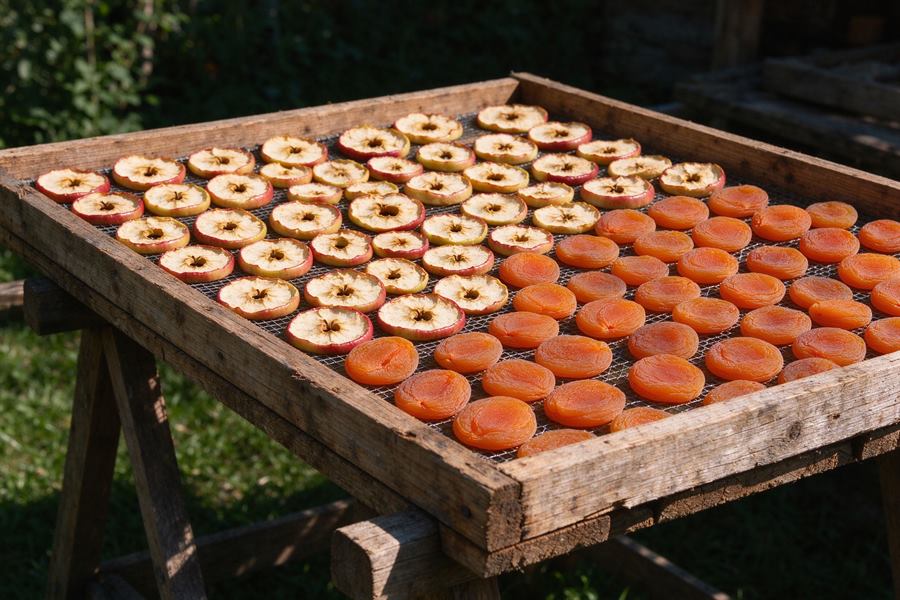
Water leaves by evaporation over three to seven days on racks or netting. Cheap, equipment-free, and entirely at the mercy of weather, dust and insects.
- final moisture
- 15–20%, uneven across the batch
- main weakness
- no control: cloud, dew and humidity change the result daily
- best for
- bulk material headed for purée or extraction
Hot air drying
50–75 °C · forced convection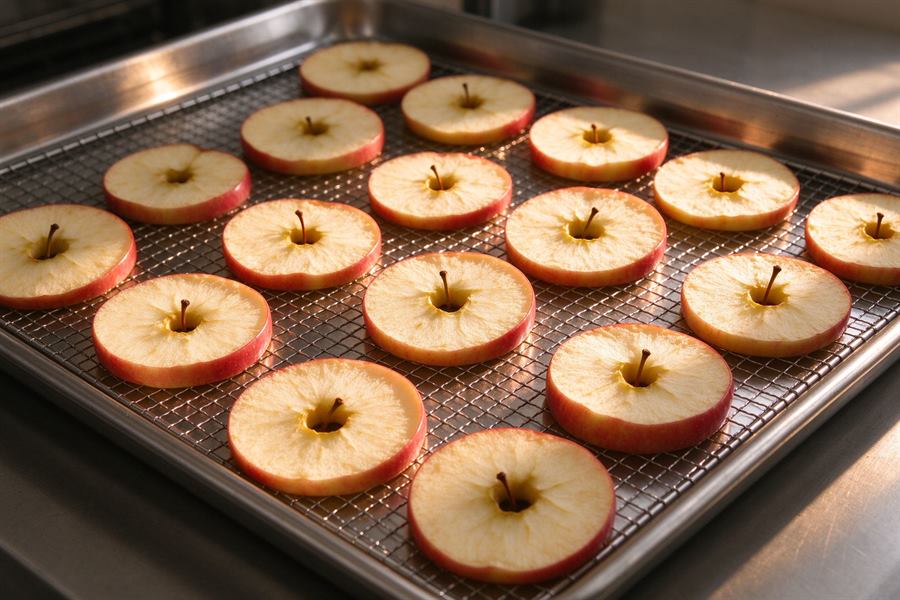
Tray, tunnel or belt dryers push heated air across the fruit for 8–24 hours, sometimes assisted by far-infrared or microwave energy. The industrial standard.
- final moisture
- 15–25%, Aw 0.60–0.70
- main weakness
- heat degrades vitamins, browns the surface, shrinks 40–60%
- best for
- volume categories decided on price per kilo
Freeze drying
−40 °C · 10–50 Pa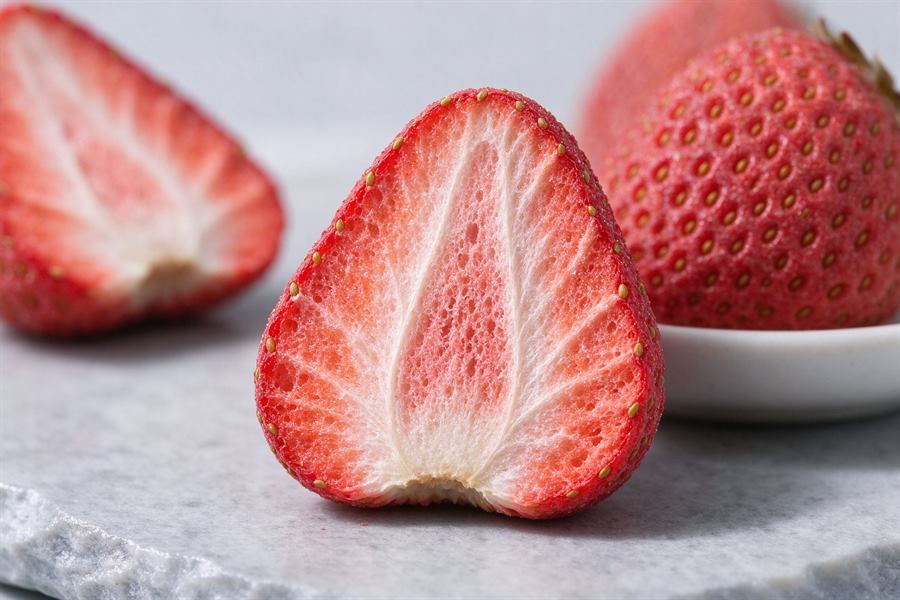
Quick-freeze, evacuate below the triple point, sublime the ice, then desorb the bound water at mild temperature. Three stages, 18–36 hours, no liquid water ever.
- final moisture
- 1–5%, Aw below 0.30
- main weakness
- 2.5–4.5 kWh per kg water, capex 3–5×
- best for
- high-value fruit where texture is the product
What the premium is actually paying for
energy2.5–4.5kWh per kg of water removed, against 0.7–1.2 for hot air
capital3–5×vacuum chamber, refrigeration and condenser replace a heater and a fan
shelf life12–24 moambient, no cold chain, freight and warehousing cost removed
Take 100 kg of fresh fruit at 85% moisture, so 15 kg of dry solids. The finished weight depends only on how much water you decide to keep.
| route | final moisture | finished weight | per 100 kg fresh |
|---|---|---|---|
| freeze-dried | 3% | 15.5 kg | 15.5% |
| hot-air dried | 18% | 18.3 kg | 18.3% |
Hot air ships about 18% more saleable weight from the same raw material, and part of that extra weight is water sold at fruit price. Freeze drying only wins when the price per kilogram rises faster than the weight falls, which is exactly what happens on berries and exactly what fails on bulk apple.
Which fruit belongs in which dryer
The commercial rule is simple: freeze-dry what the market pays for, hot-air dry everything else. The dividing line is unit value and whether colour, aroma or crispness is the reason the product exists.
| Category | Value | Route | Reason |
|---|---|---|---|
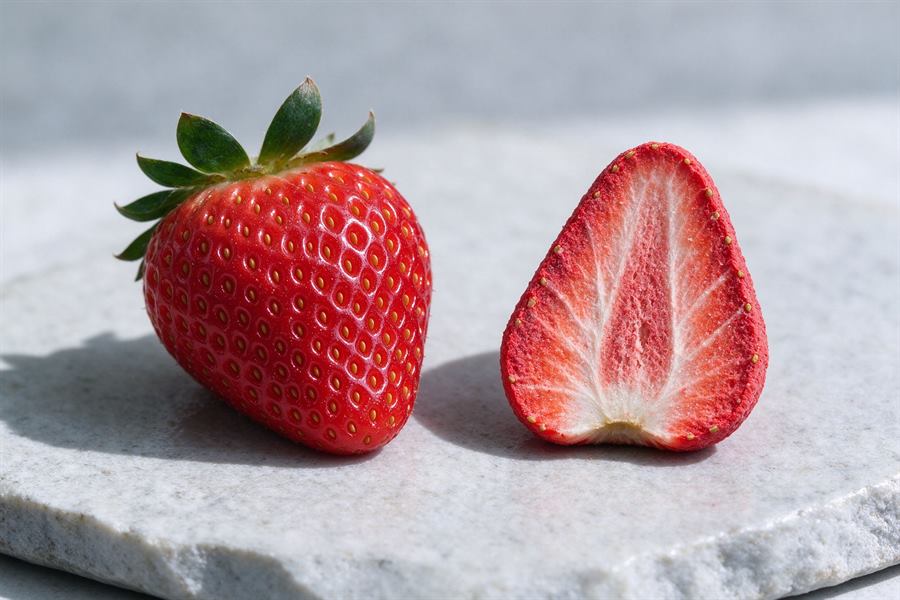
| Berries | high | freeze-dry | Colour and anthocyanins are the product; heat destroys both. |
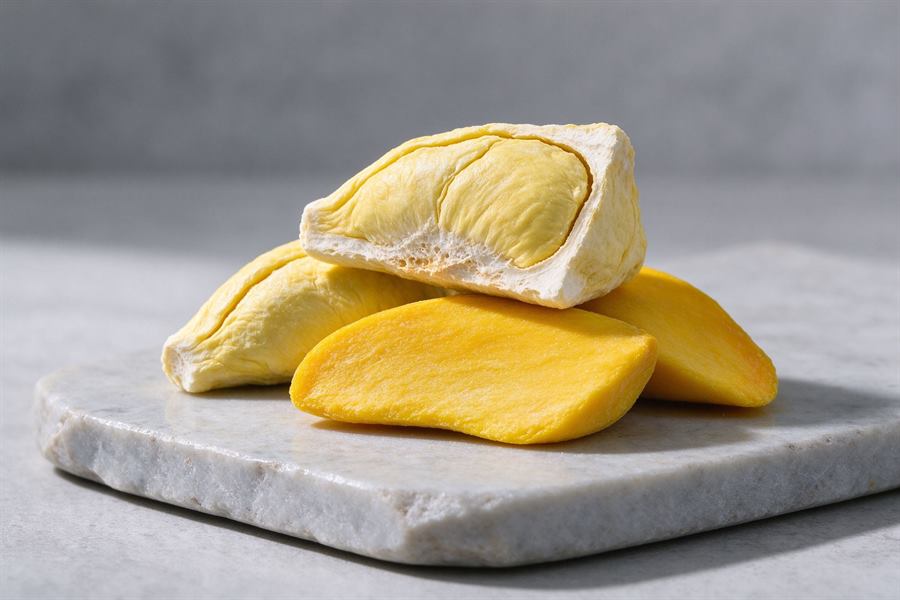
| Tropical fruit | high | freeze-dry | Shape and melt-in-mouth texture justify the premium. |
| Herbs, coffee, tea | high | freeze-dry | Aroma volatiles leave before the water does in any heated process. |
| Cultures, probiotics | very high | freeze-dry only | Living cells survive freezing and sublimation, not 60 °C. |
| Pet treats | mid–high | freeze-dry | Whole-piece appearance and a clean label command a premium. |
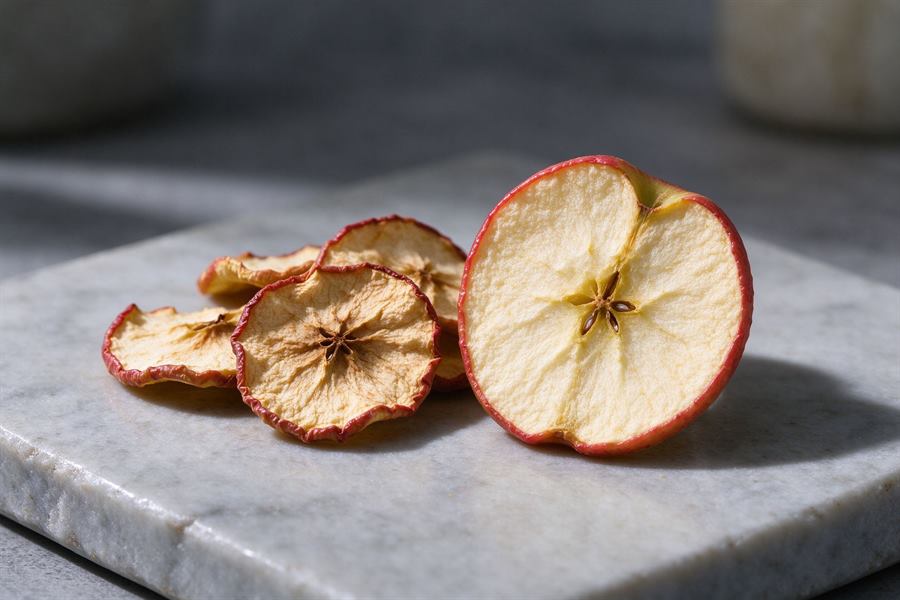
| Apple, pear, peel | mid | hot air | Commodity categories where price per kilo sets the order. |
| Purée and juice feedstock | low | hot air / spray | Appearance is irrelevant downstream; energy dominates. |
Specifying a lyophilizer
| Parameter | Why it matters | Ask for |
|---|---|---|
| Usable shelf area | Sets batch tonnage per cycle, independent of chamber volume. | peak daily input ÷ cycles per day |
| Condenser temperature | Must sit clearly below product temperature or vapour backs up and sublimation stalls. | −50 to −60 °C |
| Ultimate vacuum | Drives sublimation rate and total cycle length. | ≤10 Pa, working 10–50 Pa |
| Shelf uniformity | Uneven shelves mean uneven moisture inside one batch and rejected lots. | ±1 °C across the shelf |
| CIP / SIP | Product changeovers define real capacity in a multi-SKU plant. | integrated, not optional |
| Recipe control and logs | Export and retail audits ask for batch-level traceability. | recipes, alarms, exportable logs |
Freezing rate is a spec too, and it is usually missing from the datasheet. Slow freezing builds large ice crystals, ruptures cell walls and produces a coarse, collapsed piece. Ask how the machine controls the freezing ramp, not only the final temperature.
Questions buyers actually ask
What is the difference between freeze-dried and dehydrated fruit?
Dehydrated fruit is dried by heat, usually 50–75 °C air, and finishes at 15–25% moisture. Freeze-dried fruit is frozen to about −40 °C and dried by sublimation under vacuum, finishing at 1–5%. The routes differ in colour, texture, nutrient retention and cost.
Is freeze-dried fruit healthier than dehydrated fruit?
It retains more heat-sensitive nutrients: 80–95% of vitamin C against 10–40%, and 85–98% of berry anthocyanins against 15–30%. Both are safe, shelf-stable foods with no added preservatives, so the difference is nutrient density rather than safety.
Do they taste different?
Yes. Freeze-dried pieces are crisp and porous, dissolve quickly and keep fresh aroma. Hot-air-dried pieces are chewy and denser, with caramelised notes from sustained heat.
Why does freeze-dried fruit cost four to six times more?
Energy is 2.5–4.5 kWh per kg of water removed against 0.7–1.2 for hot air, equipment costs 3–5× more, and each batch occupies the chamber for 18–36 hours. Those three factors set the retail multiple.
How much finished product comes from 100 kg of fresh fruit?
At 85% initial moisture: about 15.5 kg freeze-dried at 3% moisture, or 18.3 kg hot-air dried at 18%. Hot air yields roughly 18% more saleable weight, part of which is water.
How long does each keep?
Freeze-dried holds 12–24 months at ambient in moisture-barrier packaging. Hot-air dried typically holds 6–12 months, with faster quality loss once the pack is opened.
Is dehydrated the same as sun-dried?
No. Sun drying is one form of dehydration, but the commercial dehydrated label usually means hot-air drying in a controlled chamber. Hygiene, cycle time and retention all differ.
Does freeze drying sterilise the fruit?
No. Microbial load is managed upstream through raw-material selection, pretreatment and hygienic handling. Low water activity only prevents growth during storage.
Start with the batch, not the machine
Fruit type, peak daily input and target moisture decide shelf area, condenser temperature and cycle length. Copy the brief template and take it to every supplier quote you compare.
Figures are planning ranges compiled from published drying and lyophilization studies; results vary by fruit, thickness, load density and cycle settings. Last updated 10 November 2026.

